
How GPT-6 Astra Is Redefining Software Engineering
For the past several years, the narrative surrounding artificial intelligence in software development has focused on code assistance. Developers typed an intent, and an AI model suggested the next three lines of code. It was convenient, but it was fundamentally passive.
The arrival of frontier models like GPT-6 Astra has permanently altered that equation. We have crossed the threshold from predictive autocompletion into true agentic execution.
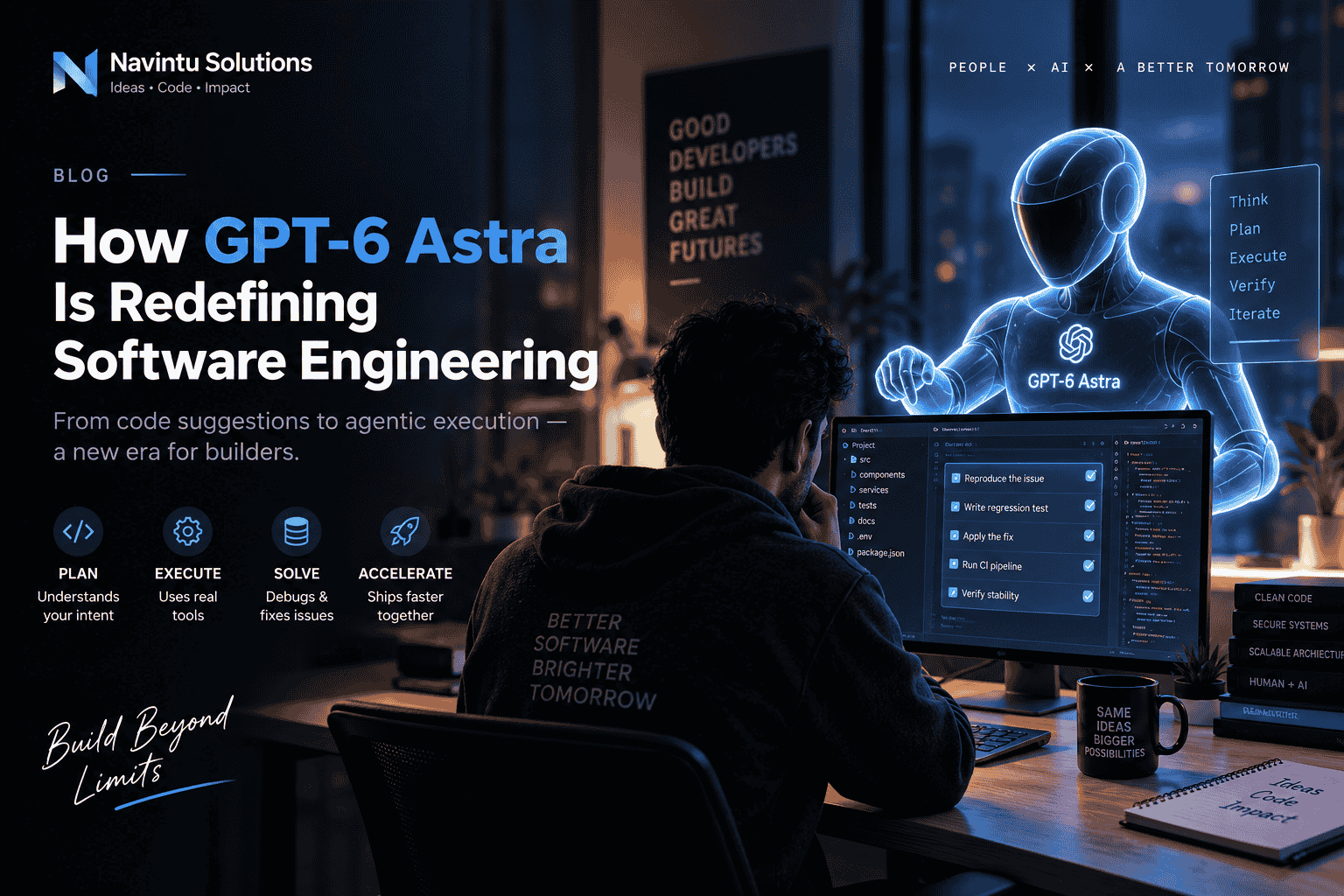
What distinguishes Astra from its predecessors is not simply larger parameter counts or cleaner syntax generation; it is native computer use. Frontier models can now navigate development environments, execute terminal commands, spin up isolated sandboxes, and trace error logs across multi-service architectures. Instead of merely suggesting a patch, an agentic model can reproduce a defect, write the regression test, apply the fix, and monitor the continuous integration pipeline to verify stability.
However, greater autonomy introduces higher architectural stakes. In an enterprise environment, raw code generation without structural governance quickly produces technical debt. Models lack organic understanding of proprietary business constraints, security perimeters, and regulatory compliance. Without strict architectural guardrails, autonomous coding tools can easily generate bloated codebases that are difficult to maintain.
This is why the competitive edge in modern engineering no longer comes from having access to AI tools—everyone has access. The real advantage lies in how those tools are directed.
At Navintu, our engineering teams treat agentic AI as an execution multiplier, not a replacement for senior architectural discipline. By pairing frontier models with rigorous human code reviews, automated integration testing, and zero-trust security boundaries, we compress month-long development cycles into focused sprints.
The future of software is not about developers being replaced by autonomous agents. It is about forward-thinking engineering teams leveraging those agents to ship resilient, production-ready software faster than ever before.
Building an AI-driven product or looking to modernize your development velocity?
Explore how our engineering team bridges frontier AI with enterprise-grade software at navintu.com
The Architectural and Business Impact of GPT-6 Astra on Modern Software Engineering
By the Engineering Team at Navintu
Introduction: The Threshold of Autonomous Engineering
For nearly four years, the conversation surrounding artificial intelligence in software development centered around assistance. Tools like early LLM copilots acted as high-speed stenographers: a software developer wrote a comment or typed the signature of a function, and the model predicted the next three lines of code. It was a noticeable boost to typing speed, but it left the cognitive architecture of software engineering fundamentally untouched. The human remained the sole operator, manually navigating files, compiling dependencies, reviewing terminal logs, and orchestrating deployments.
The arrival of frontier models like GPT-6 Astra has shattered that paradigm.
We have officially moved past the era of passive code generation and stepped into the reality of agentic execution. What makes Astra a watershed moment in computer science is not simply a jump in benchmark scores or context window size. It is the arrival of native Computer Use paired with multi-step architectural reasoning.
For the first time, an artificial intelligence model does not merely generate snippets of syntax for a human to review. It can interpret visual user interfaces, open shells, run terminal commands, debug multi-container environments, and execute complete engineering workflows from diagnosis to deployment.
For enterprise executives, startup founders, and technical leaders, this transition introduces urgent questions: How does agentic engineering actually work? What are the profound security and architectural risks of unsupervised AI code? And how do forward-thinking organizations harness this technology to build resilient, production-grade software?
1. Deconstructing GPT-6 Astra: What Makes It Different?
To understand Astra’s impact, one must look beneath the marketing headlines and inspect the technical mechanics. Previous state-of-the-art models were constrained to simple text input-output loops. They could explain an error message if you pasted it into a chat box, but they were powerless to do anything about it.
Astra operates under an entirely different operational loop characterized by three major pillars:
Native Computer Interaction
Astra is engineered to interact directly with software environments the way a human engineer does. By combining multimodal visual processing with native terminal and API execution, it can navigate browsers, inspect browser developer tools, click buttons, interact with desktop operating systems, and parse console outputs in real time. It is no longer locked in a browser chat window; it operates within the actual workspace.
Closed-Loop Fault Remediation
In traditional development, resolving a bug requires several distinct phases: identifying the failing test, reproducing the error, inspecting stack traces across distributed microservices, applying a patch, and running regression tests to ensure nothing else broke.
Astra can execute this entire cycle autonomously. When introduced to a failing test suite in an isolated development environment, the model isolates the root cause across multi-file dependencies, writes a reproducing test, applies the programmatic fix, and reruns the test suite until green lights are achieved across the board.
Multi-Repository Architectural Context
Early code models frequently suffered from “context amnesia.” They could write an isolated utility function, but they lost coherence when dealing with cross-repository interactions—such as a Next.js frontend communicating through an API gateway to a FastAPI microservice backed by PostgreSQL and Redis. Astra demonstrates an unprecedented capacity to map high-level dependency graphs, allowing it to trace how a schema migration in the database layer impacts client-side state management several layers removed.
2. The Illusion of the “Autonomous Developer”: Why Architecture Still Demands Human Expertise
Whenever a technological leap of this magnitude occurs, a chorus of premature declarations follows, claiming that human software engineers are suddenly obsolete.
The reality on the engineering front lines is far more disciplined. While Astra can write syntax and execute routine developer workflows with remarkable speed, code generation is only a fraction of software engineering.
Building software that sustains a commercial enterprise requires answering questions of architecture, longevity, security, and human experience—areas where raw generative models, if left unsupervised, introduce severe systemic fragility.
The Problem of Accelerated Technical Debt
AI models generate code by identifying statistical patterns in existing software. They do not naturally optimize for long-term modularity or elegant system design. When inexperienced teams use agentic AI without senior architectural oversight, the immediate result is often rapid feature delivery followed quickly by unmaintainable “spaghetti architecture.” Codebases swell with redundant abstractions, poorly indexed database queries, and fragile dependencies that compound into massive technical debt.
Security and the Zero-Trust Perimeter
Granting an AI model the ability to execute terminal commands and interact with software tools introduces an entirely new attack surface. Unchecked agentic workflows risk credential exposure, inadvertent package hallucination (importing non-existent, potentially malicious public packages), and subtle vulnerabilities like broken object-level authorization (BOLA). In enterprise environments handling financial transactions, health records, or proprietary customer data, agentic autonomy must be strictly bounded by zero-trust sandboxing and rigorous human governance.
Domain Logic vs. Algorithmic Synthesis
An AI model cannot negotiate edge cases with business stakeholders. It does not understand why a luxury hotel’s cancellation policy requires exceptions during peak festival seasons, or how an educational academy’s enrollment compliance laws differ between jurisdictions. Software is fundamentally an encoding of human intent and business logic. Translating messy, real-world operational challenges into structured digital systems remains an irreplaceable human discipline.