Why Growing Companies Are Quietly Walking Away From Big SaaS
If you want to see a business owner wince, ask to look at their company credit card statement from last month.
Somewhere between the cloud storage bills and email marketing tools, you will find a dozen line items for software subscriptions that no one remembers signing up for. There’s the project management tool the marketing team insisted on two years ago, the customer support platform that charges you every time you hire a seasonal worker, and the CRM that everyone complains about but nobody knows how to export data from.
For a long time, this was just considered the cost of doing business. The pitch for Software-as-a-Service (SaaS) was irresistible: why spend months building your own software when you can just pay fifty bucks a month and start working today?
It sounded like common sense. But lately, when we talk to business owners—whether they run boutique hotel chains, regional academies, logistics firms, or growing startups—the mood has completely shifted.
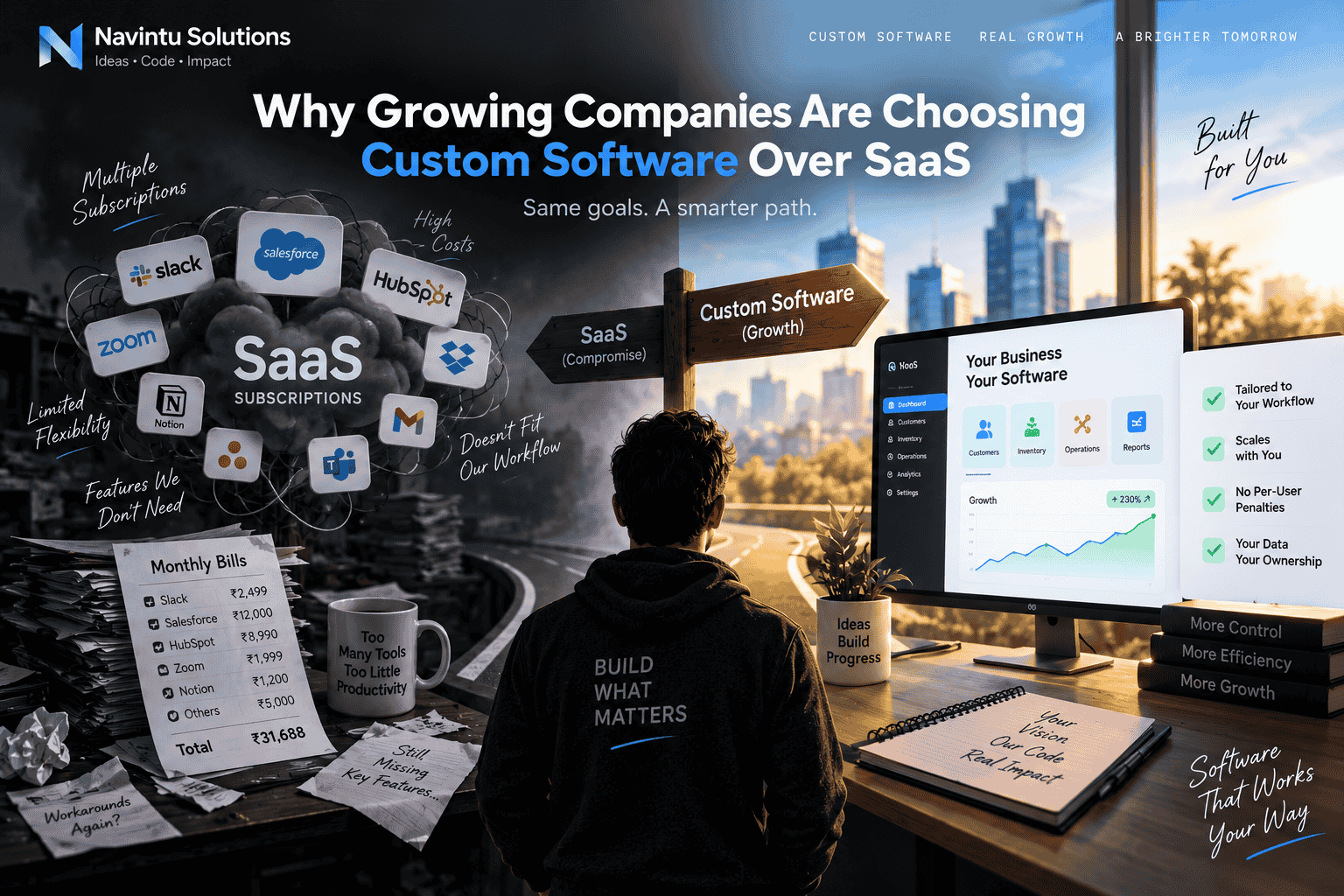
People are exhausted. They are tired of the constant price hikes, tired of training new hires on four different platforms that don’t talk to each other, and tired of paying for massive software packages where they only use three buttons.
What we are seeing now isn’t just grumbling. It’s a quiet exodus. Growing companies are walking away from the “rent-everything” model and choosing to build custom tools they actually own.
Here is what is really driving that change, and why it makes so much sense right now.
The “Per-Seat” Trap
The dirtiest trick in modern software is per-seat pricing.
When you have a tight team of five people, paying $40 a user feels like a bargain. You get enterprise-grade tools for the price of a nice lunch. But as soon as your business actually succeeds and you start hiring, the math turns against you fast.
Suddenly, you have 40 employees. That innocent $40 tool is now costing you nearly $20,000 a year. Add three other core platforms, and you’re easily burning through $60,000 to $80,000 every single year just for permission to log in.
Worse, it forces ridiculous compromises. We routinely see companies sharing logins across staff members just to avoid bumping into the next billing tier, or keeping part-time contractors out of the loop because an extra license feels wasteful. A tool that is supposed to help your team collaborate ends up putting a tax on hiring people.
The Frankenstein Workflow
Here is a scenario we hear almost every week:
A customer calls to place a custom order or book a stay. An employee takes the call, writes the details in one app, generates an invoice in another, updates inventory on an Excel sheet on their desktop, and then sends a Slack message to the floor manager so someone actually packs or prepares the order.
Why does this happen? Because no off-the-shelf SaaS tool was built for your specific business.
Big software companies have to sell to dental offices, law firms, e-commerce stores, and construction companies all at once. By trying to please everyone, they end up with tools that are 80% bloat. You are forced to contort your natural business process around their menus, tabs, and rigid fields.
When things don’t fit, teams do what humans always do: they create workarounds. They spin up Zapier zaps that break every three weeks, or they fall back on trusty, chaotic spreadsheets.
Before you know it, your business is running on a digital Frankenstein monster held together by duct tape and hope.
Why Custom Software Isn’t Just for Tech Giants Anymore
Ten years ago, if you told someone you were building custom software for your mid-sized business, they would have called you crazy. Back then, building bespoke software meant hiring a team of engineers, buying physical servers, and spending half a million dollars before seeing a working prototype.
That world is gone.
Modern engineering has changed completely. With today’s cloud infrastructure, modern web frameworks like Next.js and TypeScript, and reliable open-source components, building custom software is no longer a multi-year slog. What used to take eighteen months can now be built and launched in a matter of weeks.
Instead of paying a monthly rent to a software giant that raises its prices by 15% every January, companies are paying once to build a clean, lightweight system tailored specifically to how they work.
Think about the difference between renting an apartment and owning a house:
- When you rent SaaS, the money leaves your bank account forever. You build zero equity, and you are always subject to the landlord’s rules.
- When you build custom software, that code is an asset that sits on your company’s balance sheet. It adds tangible enterprise value to your business if you ever decide to sell or bring in investors.
What a Custom Tool Actually Looks Like in Real Life
When people hear “custom software,” they often picture something impossibly complex with hundreds of screens.
In reality, the best custom software is shockingly simple. It’s refreshing because of what it doesn’t have.
At Navintu, when we build internal tools for our clients, the goal is always clarity.
For a regional hotel, it might be a direct-booking engine that bypasses expensive booking portal commissions, paired with a simple iPad screen for the front desk that handles check-ins, room cleaning statuses, and maintenance requests in one place.
For an educational academy, it might be a clean portal where parents pay tuition, students see their schedules, and teachers log attendance—replacing three separate clunky systems with one clean, unified login.
For a traditional business, it might simply be replacing five messy spreadsheets with a cloud-based dashboard that shows inventory, sales, and shipments in real time.
There are no confusing settings menus, no extra features trying to upsell you on an enterprise tier, and no per-user fees. If you hire ten new employees tomorrow, you just create ten accounts. It costs you nothing extra.
The Question Every Business Owner Should Ask
If your current software setup is running smoothly and your team loves it, by all means, keep it. Don’t fix what isn’t broken.
But if you find yourself constantly working around your software instead of having it work for you—or if you look at your software invoices every month with a knot in your stomach—it’s time to rethink the equation.
Software should remove headaches, not create them. And in 2026, you no longer have to settle for someone else’s idea of how your company should run.
Let’s Build Something That Actually Fits Your Business
At Navintu, we don’t believe in over-engineering or building things you don’t need. We sit down with you, look at your actual day-to-day workflow, and build simple, powerful software that your team will genuinely enjoy using.
If you’re curious about what a custom tool could look like for your business—and what it might save you on software subscriptions—let’s talk.
👉 Drop us a message at navintu.com and let’s start a conversation. No sales pressure, just honest engineering advice.